
Home > Blog detail
Oct 2026
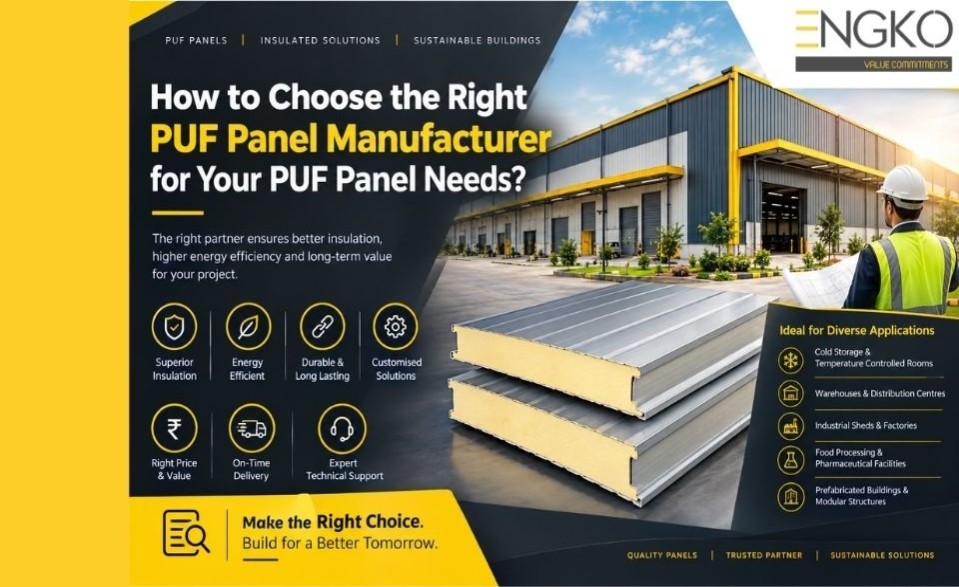
Choosing the right partner for your PUF panel needs is a key decision for any industrial, commercial, or infrastructure project. Whether you are planning a cold storage facility, warehouse, factory shed, food processing unit, pharmaceutical facility, or prefabricated building, the quality of your PUF panels directly affects thermal insulation, energy efficiency, durability, and long-term operating costs.
With several PUF panel manufacturers and suppliers available in India, selecting the right company requires more than comparing prices. You need a reliable partner who understands your project requirements, provides quality products, offers technical guidance, and delivers solutions that meet your performance expectations.
In this blog, we will explore the key factors to consider when choosing the right PUF panel manufacturer or supplier for your project.
PUF panels, also known as Polyurethane Foam panels, are insulated sandwich panels consisting of a rigid polyurethane foam core between two protective metal sheets. These panels are widely used in industrial and commercial construction for their excellent thermal insulation, lightweight structure, and quick installation.
PUF insulated panels are commonly used in:
Cold storage rooms and temperature-controlled facilities
Pre-engineered buildings (PEB) and industrial sheds
Warehouses and distribution centres
Food processing and pharmaceutical facilities
Prefabricated buildings and modular structures
Clean rooms and controlled environments
Commercial buildings and insulated roofing systems
Selecting the right PUF panel solution can help maintain the required indoor temperature, reduce unwanted heat transfer, and improve building performance.
The first step in choosing a PUF panel partner is to evaluate their industry experience and technical expertise. An experienced manufacturer is more likely to understand the challenges associated with different applications, including cold storage, industrial roofing, wall cladding, and temperature-controlled environments.
Before finalising a supplier, consider the following:
How long has the company been involved in PUF panel manufacturing?
Does it understand your particular industry and application?
Can it provide examples of completed or ongoing projects?
Does it offer technical support during product selection and installation?
Can it handle your required project volume and delivery schedule?
A knowledgeable partner can help you choose suitable panel specifications and avoid common mistakes during project planning.
Product quality is one of the most important factors when selecting a PUF panel manufacturer in India. Poor-quality panels can lead to insulation problems, premature deterioration, moisture-related issues, and higher maintenance costs.
Before purchasing PUF panels, evaluate their core material, metal sheet quality, dimensional accuracy, joint design, and overall manufacturing consistency.
Ask the manufacturer about:
Foam density and thermal insulation performance
Insulation thickness and panel dimensions
Metal sheet thickness and coating specifications
Panel joint design and sealing arrangements
Relevant product test reports and quality documentation
Applicable fire-performance test results, where required
Always verify technical claims against product documentation and project requirements. Do not assume that every PUF panel has the same insulation performance or fire resistance.
Not every PUF panel is suitable for every project. The correct selection depends on the intended application, operating temperature, environmental conditions, structural requirements, and installation method.
Cold rooms and cold storage facilities require carefully selected insulation thickness, effective joint sealing, and appropriate vapour-control detailing. The correct specification depends on the required temperature, humidity, operating conditions, and room design.
PUF panels used in pre-engineered buildings can provide insulated roofing and wall cladding. They are suitable for applications where improved thermal performance is important, including industrial facilities, warehouses, and manufacturing units.
Industrial sheds and warehouses may benefit from insulated roofing and wall systems that help manage indoor temperatures. The right solution depends on building use, ventilation, local climate, and operational requirements.
Clean rooms and pharmaceutical environments may require smooth, easy-to-clean panel surfaces, well-sealed joints, and materials compatible with hygiene and contamination-control requirements.
A reliable PUF panel partner should assess your application before recommending the product specification.
One of the main reasons businesses choose PUF panels is their thermal insulation capability. However, insulation performance varies according to foam properties, panel thickness, joint design, and installation quality.
When comparing PUF panels, ask for information about thermal conductivity, declared thermal resistance, and the relevant test conditions. Consider the complete building envelope rather than evaluating the panel alone.
For cold storage facilities, poor joint sealing or thermal bridges can reduce the effectiveness of an otherwise well-insulated panel system.
The right manufacturer should help you select suitable insulation thickness based on your project’s temperature requirements, energy-efficiency objectives, and operating conditions.
Every project has different technical and architectural requirements. Therefore, it is beneficial to work with a PUF panel supplier that can offer suitable product configurations.
Depending on the manufacturer's capabilities, available options may include:
Different panel thicknesses
Insulated roofing and wall panels
Different metal facings and coating options
Multiple panel lengths and profiles
Suitable joint configurations
Colour options and project-specific dimensions
Before placing an order, confirm which options are available, their technical specifications, and whether they meet your project's design requirements.
A suitable partner should also coordinate panel specifications with the building design to minimise unnecessary cutting, wastage, and installation difficulties.
Price is an important consideration, but selecting the lowest-priced PUF panel is not always the most economical decision.
The total project cost may include panel supply, transportation, installation, accessories, flashing, sealants, wastage, and future maintenance. Differences in insulation performance and product quality can also affect operating expenses over time.
When comparing quotations from PUF panel manufacturers, check whether they include:
Panel thickness and specifications
Metal sheet thickness and coating details
Foam properties and insulation performance
Accessories and installation components
Transportation and delivery terms
Installation services, if required
Warranty terms and after-sales support
Request quotations based on the same technical specifications so that you can make a fair comparison. A transparent quotation helps you understand exactly what you are paying for.
Project delays can increase labour costs, disrupt construction schedules, and postpone facility operations. Before selecting a PUF panel supplier, confirm whether the company can manufacture and deliver the required quantity within your timeline.
Discuss the following points:
Production capacity and current order commitments
Availability of the required panel specifications
Expected manufacturing lead time
Transportation arrangements
Packaging and material protection
Delivery coordination with the construction schedule
For large industrial projects, warehouses, and cold storage facilities, reliable planning and communication are especially important.
Choose a partner who provides realistic delivery commitments and communicates promptly if any changes occur.
Even high-quality PUF panels can underperform if they are installed incorrectly. Improper joint sealing, damaged facings, inadequate flashing, and poor detailing around openings can compromise the insulation system.
An experienced supplier should be able to provide product installation guidelines and clarify technical requirements. Where installation services are offered, confirm the scope of work, site supervision arrangements, and responsibility for workmanship.
For cold rooms, special attention should be given to floor-wall junctions, ceiling connections, door openings, vapour barriers, and penetrations. For industrial roofing, proper fastening, weatherproofing, drainage, and compatibility with the supporting structure are essential.
Before finalising your PUF panel order, review the manufacturer's available documentation. Depending on your application, this may include product specifications, material test reports, thermal performance data, and relevant fire-performance test reports.
If your project has specific regulatory, insurance, hygiene, or fire-safety requirements, confirm that the proposed panel system meets the applicable criteria.
You should also clarify the warranty terms, including:
What components and defects are covered
The warranty period and conditions
Exclusions related to installation or misuse
The process for reporting product issues
The availability of technical assistance after delivery
Ask for written confirmation rather than relying only on verbal assurances.
A manufacturer's reputation can provide useful insight into its reliability, communication, and service quality. However, reviews should be considered alongside technical evidence and project references.
Before choosing a PUF panel supplier, review its previous projects, customer feedback, business experience, and responsiveness to enquiries.
If possible, request references from customers who have completed projects similar to yours. Their feedback may help you understand the supplier's delivery performance, product consistency, and after-sales service.
A dependable partner should be transparent about product capabilities, project limitations, and realistic expectations.
Engko Engineering provides solutions for businesses looking for PUF panels and prefabricated construction systems. With applications across industrial and commercial construction, the right product selection can help project owners meet their insulation and building requirements.
When evaluating Engko Engineering or any other manufacturer, discuss your project requirements in detail to identify a suitable solution for your application.
Whether you are planning an insulated warehouse, industrial shed, cold room, or prefabricated facility, consider the following before requesting a quotation:
Intended application and building dimensions
Required insulation thickness
Roofing or wall panel requirements
Site location and environmental conditions
Project schedule and estimated quantity
Any specific technical or compliance requirements
Sharing these details helps the supplier prepare a more relevant technical proposal and quotation for your project.
Avoid these common mistakes when purchasing PUF panels:
Choosing only on price: Compare specifications and the complete project cost, not just the price per square foot.
Ignoring insulation requirements: Select panel thickness according to the intended use and required thermal performance.
Overlooking product documentation: Verify specifications, test reports, and applicable compliance requirements.
Ignoring installation quality: Ensure correct joint sealing, fastening, flashing, and detailing.
Failing to confirm delivery schedules: Establish realistic manufacturing and transportation timelines before ordering.
Not checking warranty conditions: Understand what is covered and how product issues will be addressed.
Using the same panel specification for every project: Different applications require different technical considerations.
Avoiding these mistakes can help you make a more informed purchasing decision and reduce the risk of costly problems later.
Look for a manufacturer with relevant industry experience, consistent product quality, documented technical specifications, suitable manufacturing capacity, reliable delivery, and responsive technical support. Compare quotations using the same specifications.
PUF panel prices depend on insulation thickness, foam properties, metal sheet thickness, coating, panel profile, quantity, transportation, accessories, and installation requirements.
The required thickness depends on the target storage temperature, room dimensions, operating conditions, insulation performance, and energy-efficiency objectives. A technical assessment should determine the appropriate specification.
Yes. PUF panels can be used for insulated roofing and wall cladding in warehouses and industrial buildings where thermal performance is important. The appropriate panel system depends on the building design and intended use.
Request product datasheets, panel specifications, relevant thermal performance data, applicable test reports, warranty details, and installation guidelines. Additional documentation may be necessary for projects with specific compliance requirements.
Correct installation helps maintain insulation performance, joint integrity, weather resistance, and long-term durability. Poor installation can result in air leakage, moisture problems, and thermal bridging.
Share your project location, application, required panel thickness, approximate quantity, panel dimensions, and expected delivery schedule with the manufacturer. These details help the supplier prepare a more accurate quotation.
Choosing the right partner for your PUF panel needs is about finding the right balance between product quality, insulation performance, technical expertise, delivery reliability, and long-term value.
Before placing an order, evaluate the manufacturer's experience, verify technical documentation, compare quotations carefully, and confirm installation support and warranty terms. A well-informed decision can help improve building performance and support the long-term success of your project.
If you are planning a cold storage facility, insulated warehouse, industrial shed, or prefabricated building, connect with Engko Engineering to discuss your PUF panel requirements and explore suitable solutions for your project.
Choose the right panels, work with a reliable partner, and build with confidence.
Call
: +91-9667986005